
Introduction
- Fewer than 5% of people who say they are penicillin allergic are truly allergic (Copaescu 2023; Shenoy 2019).
- True IgE-mediated penicillin allergies that cause anaphylaxis are rare.
- An IgE-mediated penicillin allergy can diminish over time — about 80% of patients become tolerant after a decade.
- Patients with a documented penicillin allergy may be inappropriately exposed to alternative antibiotics, resulting in increased treatment failures, adverse effects, and antimicrobial resistance.
- Penicillins, cephalosporins, and carbapenems all share a beta-lactam core, raising the potential for cross-reactivity among these agents.
Pharmacology
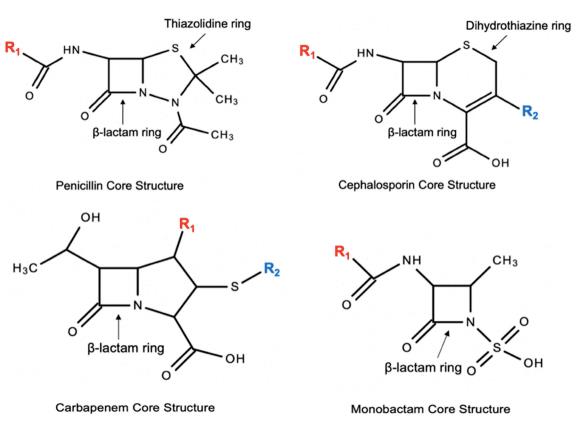
- The drugs within each group below may cross-react with each other because they share similar side chains.
- Cross-reactivity between penicillins and cephalosporins is about 2% (Shenoy 2019), and about 1% for later-generation cephalosporins (Challen 2026).
- Cefazolin is NOT likely to cross-react with penicillin (its R1 side chain is not similar to that of any current FDA-approved beta-lactam; Chaudhry 2019). For patients with a history of anaphylaxis to a penicillin, the 2022 drug allergy practice parameter suggests that a cephalosporin with a structurally dissimilar R1 side chain can be given without testing or additional precautions (Khan 2022, statement 12; conditional recommendation, moderate certainty), and its executive summary names cefazolin as an example.
- Cross-reactivity between penicillins and monobactams (e.g., aztreonam) is very low (Gaeta 2015; Wurpts 2020). Aztreonam and ceftazidime share an identical side chain, so use caution between those two. The 2022 practice parameter suggests aztreonam may be given without prior testing to patients with a penicillin or cephalosporin allergy unless there is a history of ceftazidime allergy (Khan 2022, statement 18; conditional recommendation, moderate certainty).
- Cross-reactivity between penicillins and carbapenems is <1%. The 2022 practice parameter suggests a carbapenem may be given without testing or additional precautions to patients with a penicillin or cephalosporin allergy (Khan 2022, statement 17; conditional recommendation, moderate certainty).
| Group 1 | Group 2 | Group 3 | Group 4 |
|---|---|---|---|
| Penicillin Cefoxitin | Amoxicillin Ampicillin Cefaclor Cephalexin Cefadroxil | Ceftriaxone Cefotaxime Cefuroxime Cefepime Cefpodoxime Ceftaroline Ceftolozane | Aztreonam Ceftazidime |
These groupings reflect structural side-chain similarity (Chaudhry 2019; Wurpts 2020), a theoretical predictor of risk. Observed clinical cross-reactivity is low (about 1 to 2%; Shenoy 2019; Campagna 2012), and documented tolerance can override the chart: cefuroxime, for example, is listed here by side-chain similarity but was tolerated in challenges with cefuroxime axetil and ceftriaxone by all 244 penicillin-allergic patients who had negative cephalosporin skin tests in Romano 2018.
Evidence
| Author, year | Design | Intervention & comparison | Outcome |
|---|---|---|---|
| Mechanism — why cross-reactivity? | |||
| Nagakura, 1991 & Mayorga, 1995 | Laboratory (monoclonal antibody) studies | Monoclonal antibodies raised against ampicillin (Nagakura) and amoxicillin (Mayorga) protein conjugates | Mayorga: 92% of the antibodies recognized an epitope in which the side chain was a major constituent. Nagakura: one antibody bound the ring and cross-reacted widely; the other bound the side chain and cross-reacted only with drugs sharing it (ampicillin, cephalexin). The side chain is a major target of the antibody response |
| Cephalosporin cross-reactivity | |||
| Goodman, 2001 | Retrospective review (n = 2933) | Orthopedic patients; 413 were penicillin allergic and most (300, per Chaudhry 2019) received a cephalosporin, usually cefazolin, during the procedure | Only 1 patient may have had a reaction (about 0.3%, 1 of 300); patients with severe or anaphylactic histories were probably excluded |
| Daulat, 2004 | Retrospective review (n = 606) | Penicillin-allergic patients receiving cephalosporins | Only 1 reaction in 606 patients (about 0.2%, as tabulated in Michaud 2023) |
| Apter, 2006 | Retrospective cohort (UK primary care database; 3,375,162 penicillin recipients, 506,679 later given a cephalosporin) | Penicillin prescription followed by a cephalosporin prescription; allergic-like events within 30 days | Absolute risk of anaphylaxis after a cephalosporin was less than 0.001%. A prior allergic-like event after penicillin raised the risk of an event after a cephalosporin (risk ratio 10.1) and after a sulfonamide antibiotic (7.2), so cross-reactivity does not fully explain it |
| Romano, 2018 | Prospective study (n = 252) | IgE-mediated penicillin hypersensitivity: cefaclor specific-IgE assay + skin tests to 9 cephalosporins; challenges if skin tests negative | 99 (39.3%) had positive cephalosporin tests, mostly to agents sharing side chains with penicillins; all 244 challenged (negative skin tests) tolerated cefuroxime axetil and ceftriaxone; 7 reacted to cefaclor or cefadroxil |
| Carbapenem cross-reactivity | |||
| Romano, 2006 | Prospective study (n = 112) | Penicillin skin-test-positive patients skin tested to imipenem | Only 1 positive imipenem skin test (cross-reactivity 0.9%) |
| Romano, 2007 | Prospective study (n = 104) | Penicillin skin-test-positive patients skin tested to meropenem; if negative, escalating-dose challenge | Only 1 positive meropenem skin test (cross-reactivity 0.9%); all 103 skin-test-negative patients tolerated the challenge |
| Atanaskovic-Markovic, 2008 | Prospective study in children (n = 108) | Children with penicillin allergy skin tested to penicillin and meropenem; if negative, challenge | Only 1 positive meropenem skin test (cross-reactivity 0.9%); all 107 skin-test-negative children tolerated the challenge |
| Recent evidence (2020–2026) — risk-stratification & de-labeling | |||
| Trubiano, 2020 (PEN-FAST) | Derivation & validation cohorts (622 derivation and internal validation; 945 external validation) | Clinical decision rule to risk-stratify reported penicillin allergy | A PEN-FAST score <3 = low risk; only 17 of 460 low-risk patients (3.7%) had a positive allergy test (negative predictive value 96.3%) — supports challenge without prior skin testing |
| Khan, 2022 (Practice Parameter) | Practice parameter (consensus-based statements) | 2022 drug allergy practice parameter update; only statements 4, 8, 9, 12, 17 and 18 are cited on this page | Strong recommendations (moderate certainty): make a proactive effort to delabel penicillin allergy (statement 4); do not skin test before a direct amoxicillin challenge in children with a benign cutaneous reaction (statement 8). Conditional (low certainty): consider direct amoxicillin challenge in adults whose benign cutaneous reaction was more than 5 years ago (statement 9). Conditional (moderate certainty): a structurally dissimilar R1 cephalosporin after penicillin anaphylaxis (statement 12), a carbapenem (statement 17), or aztreonam unless ceftazidime allergy (statement 18), each without testing |
| Copaescu, 2023 (PALACE) | Randomized noninferiority trial (n = 377) | Direct oral penicillin challenge vs. skin testing followed by oral challenge in low-risk penicillin allergy | Positive reactions 0.5% (1/187) with direct oral challenge vs. 0.5% (1/190) with skin-test-first — direct oral challenge was noninferior |
| He, 2026 | Systematic review (18 guidelines, 2014 to 2024) | Compared the scope and recommendations of penicillin allergy de-labeling guidelines and rated their quality (AGREE II) | Many supported direct de-labeling or direct challenge in low-risk patients, but risk tools and eligibility rules differed and only 2 of 18 guidelines were high quality |
| Kosztulska, 2026 | Systematic review | Basophil activation test and specific IgE for suspected immediate penicillin allergy | Both have limited sensitivity and specificity, and no clear guideline says where they fit; drug provocation testing remains the gold standard |
| Zimmer, 2026 | Retrospective pre-post study (n = 235) | Patients with intermediate-, high-, or severe-risk penicillin allergy labels, before vs. after a penicillin-cephalosporin cross-reactivity alert was removed from the electronic health record | Cephalosporin use rose from 27% to 67% (P < 0.001); no patient had an allergic reaction to a cephalosporin |
Conclusions
- True penicillin allergies are less common than reported, and anaphylaxis is uncommon.
- Cross-reactivity among penicillins and cephalosporins is attributed to similarity in side chains.
- Cephalosporin cross-reactivity with penicillins is much lower than reported in early studies, partly because early cephalosporin preparations were most likely contaminated with a small amount of penicillin (Wurpts 2020).
- Cross-reactivity between penicillins and cephalosporins is about 2%, and with carbapenems is <1%.
- These cross-reactivity rates have not materially changed; what has shifted is practice toward penicillin-allergy de-labeling. Validated risk-stratification (PEN-FAST, 2020) identifies low-risk patients in whom direct oral penicillin challenge without prior skin testing was safe and noninferior to skin testing first in a randomized trial (PALACE RCT 2023). Guidelines still differ on who qualifies, so follow your site's protocol (He 2026).
- The 2022 drug allergy practice parameter recommends a proactive effort to delabel patients with a reported penicillin allergy, if appropriate (Khan 2022, statement 4; strong recommendation, moderate certainty).
- For direct amoxicillin challenge, the 2022 practice parameter recommends against penicillin skin testing first in children with a benign cutaneous reaction (statement 8; strong recommendation, moderate certainty). In adults it suggests considering a direct amoxicillin challenge only when the reaction was benign, cutaneous, and more than 5 years ago (statement 9; conditional recommendation, low certainty).
- For low-risk patients, de-labeling often makes cross-reactivity calculations unnecessary. When a true penicillin allergy is confirmed, selecting a cephalosporin or carbapenem with a dissimilar side chain (e.g., cefazolin) keeps cross-reactivity low.
References
- Apter AJ, Kinman JL, Bilker WB, et al. Is There Cross-Reactivity Between Penicillins and Cephalosporins? Am J Med. 2006;119(4):354e11-19.
- Atanaskovic-Markovic M, Gaeta F, Medjo B, Viola M, Nestorovic B, Romano A. Tolerability of Meropenem in Children with IgE-Mediated Hypersensitivity to Penicillins. Allergy. 2008;63:237-240.
- Campagna JD, Bond MC, Schabelman E, Hayes BD. The Use of Cephalosporins in Penicillin-Allergic Patients: A Literature Review. J Emerg Med. 2012;42(5):612-620.
- Challen K. Cephalosporins Should be Avoided in Patients with Penicillin Allergy. Emerg Med Clin North Am. 2026;44(3):507-521. doi: 10.1016/j.emc.2026.01.006.
- Chaudhry SB, Veve MP, Wagner JL. Cephalosporins: A Focus on Side Chains and Beta-Lactam Cross-Reactivity. Pharmacy. 2019;7:1-16.
- Daulat S, Solensky R, Earl HS, Casey W, Gruchalla RS. Safety of Cephalosporin Administration to Patients with Histories of Penicillin Allergy. J Allergy Clin Immunol. 2004;113(6):1220-1222. doi: 10.1016/j.jaci.2004.03.023.
- Gaeta F, Valluzzi RL, Alonzi C, et al. Tolerability of Aztreonam and Carbapenems in Patients with IgE-Mediated Hypersensitivity to Penicillins. J Allergy Clin Immunol. 2015;135(4):972-976. doi: 10.1016/j.jaci.2014.10.011.
- Goodman EJ, Morgan MJ, Johnson PA, Nichols BA, Denk N, Gold BB. Cephalosporins can be Given to Penicillin-Allergic Patients Who Do Not Exhibit an Anaphylactic Response. J Clin Anesth. 2001;13(8):561-564.
- He J, Guirguis M, Devanandan S, et al. Quality and Consistency of Penicillin Allergy Delabelling Guidelines: A Systematic Review. Clin Exp Allergy. 2026;56(8):867-880. doi: 10.1111/cea.70269.
- Kosztulska B, Rydzyńska M, Grześk-Kaczyńska M, et al. Are Basophil Activation Test (BAT) and IgE Levels Useful Tools in Confirming Penicillin Allergy? Novel Diagnostic Approach in Beta-Lactams Hypersensitivity Reactions: A Systematic Review. Int J Mol Sci. 2026;27(17). doi: 10.3390/ijms27177960.
- Mayorga C, Obispo T, Jimeno L, et al. Epitope Mapping of Beta-Lactam Antibiotics with the Use of Monoclonal Antibodies. Toxicology. 1995;97:225-234.
- Michaud L, Yen HH, Engen DA, et al. Outcome of Preoperative Cefazolin Use for Infection Prophylaxis in Patients with Self-Reported Penicillin Allergy. BMC Surg. 2023;23(1):32. doi: 10.1186/s12893-023-01931-w.
- Nagakura N, Souma S, Shimizu T, Yanagihara Y. Anti-Ampicillin Monoclonal Antibodies and their Cross- Reactivities to Various Beta-Lactams. J Antimicrob Chemother. 1991;28(3):357-368. doi: 10.1093/jac/28.3.357.
- Romano A, Viola M, Gueant-Rodriguez RM, Gaeta F, Pettinato R, Gueant JL. Imipenem in Patients with Immediate Hypersensitivity to Penicillins. N Engl J Med. 2006;354:2835-2837.
- Romano A, Viola M, Gueant-Rodriguez RM, Gaeta F, Valluzzi R, Gueant JL. Brief Communication: Tolerability of Meropenem in Patients with IgE-Mediated Hypersensitivity to Penicillins. Ann Intern Med. 2007;146:266-269.
- Shenoy ES, Macy E, Rowe T, Blumenthal KG. Evaluation and Management of Penicillin Allergy: A Review. JAMA. 2019;321(2):188-199.
- Romano A, Valluzzi RL, Caruso C, Maggioletti M, Quaratino D, Gaeta F. Cross-Reactivity and Tolerability of Cephalosporins in Patients with IgE-Mediated Hypersensitivity to Penicillins. J Allergy Clin Immunol Pract. 2018 Sep-Oct;6(5):1662-1672. doi: 10.1016/j.jaip.2018.01.020. Epub 2018 Feb 3. PMID: 29408440.
- Khan DA, Banerji A, Blumenthal KG, et al. Drug allergy: A 2022 practice parameter update. J Allergy Clin Immunol. 2022;150(6):1333-1393. doi: 10.1016/j.jaci.2022.08.028.
- Trubiano JA, Vogrin S, Chua KYL, et al. Development and Validation of a Penicillin Allergy Clinical Decision Rule. JAMA Intern Med. 2020;180(5):745-752. doi: 10.1001/jamainternmed.2020.0403.
- Copaescu AM, Vogrin S, James F, et al. Efficacy of a Clinical Decision Rule to Enable Direct Oral Challenge in Patients With Low-Risk Penicillin Allergy: The PALACE Randomized Clinical Trial. JAMA Intern Med. 2023;183(9):944-952. doi: 10.1001/jamainternmed.2023.2986.
- Wurpts G, Aberer W, Dickel H, et al. Guideline on Diagnostic Procedures for Suspected Hypersensitivity to Beta-Lactam Antibiotics: Guideline of the German Society for Allergology and Clinical Immunology (DGAKI) in collaboration with the German Society of Allergology (AeDA) and other societies. Allergol Select. 2020;4:11-43. doi: 10.5414/ALX02104E.
- Zimmer A, Zagari J, Sudnik P, et al. Cephalosporin Use and Patient Outcomes Following Removal of Penicillin-Cephalosporin Cross-Reactivity Alerts from the Electronic Health Record. Antimicrob Agents Chemother. 2026;70(6):e0182025. doi: 10.1128/aac.01820-25.
Tags:penicillin allergy
cross-reactivity
cephalosporin
carbapenem
Never Miss a Friday Pearl
Get Pharmacy Pearls in your inbox every Friday
Free weekly clinical pearls written for pharmacists. Practical, evidence-based, and built for bedside use.
Free forever. Unsubscribe anytime. No spam, ever.